
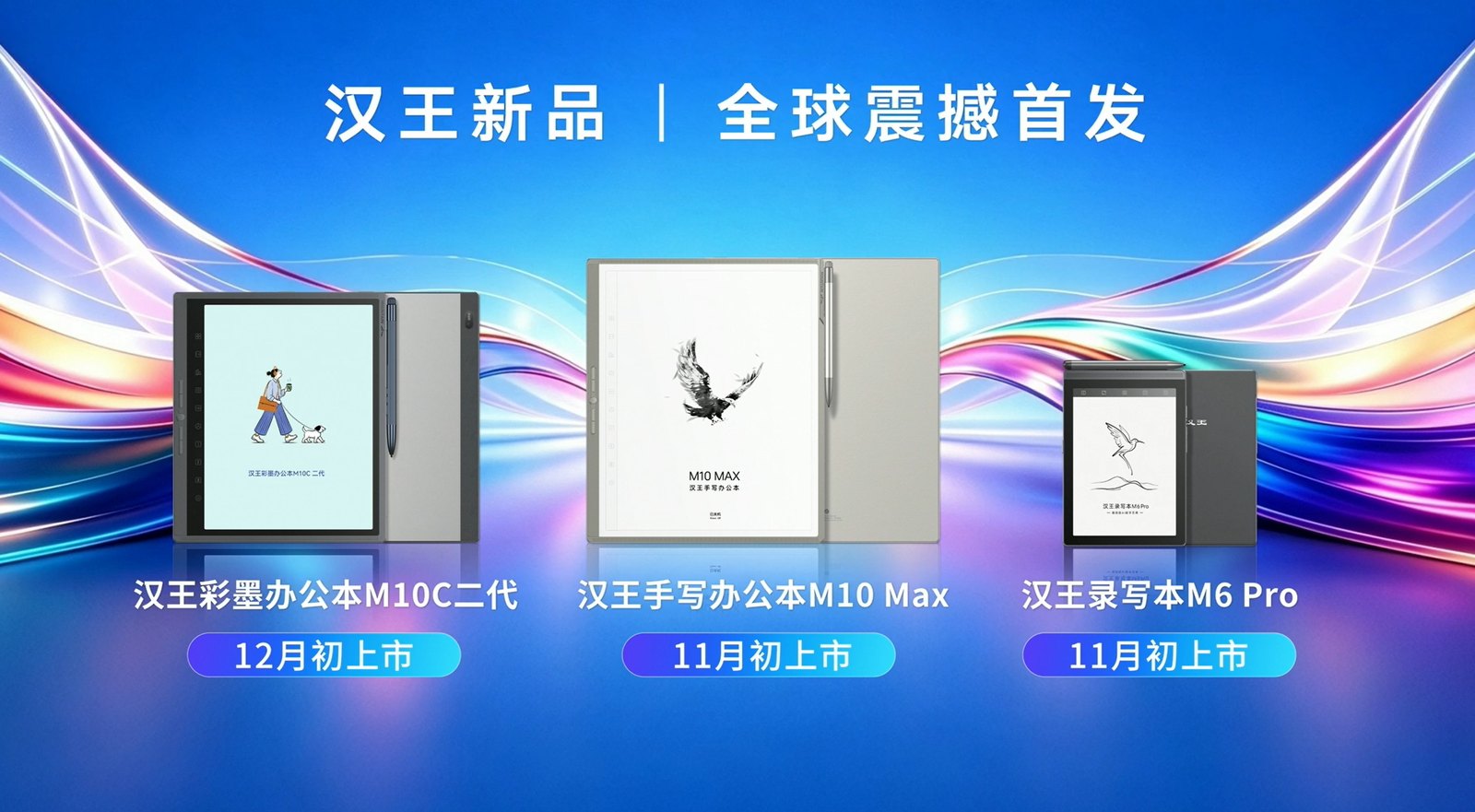




Caption: Hanvon announced release timing for its three new devices at the forum: the M10C 2nd Gen in early December, the M10 Max and M6 Pro in early November. Source: Hanvon livestream on bilibili
*Translation note: This English version was translated from the original Traditional Chinese article with assistance from Claude, Anthropic's AI model.*
After more than four years, E Ink Kaleido 4 is finally official. On the afternoon of October 15, 2026, Hanvon hosted the 2nd E-Paper Ecosystem and Industrial Integration Innovation Development Forum in Beijing. E Ink took the stage to walk through what is new in Kaleido 4, and Hanvon followed by unveiling what it calls the first product to use it: the M10C 2nd Gen color ePaper office notebook, due in China in early December.
Hanvon also announced two black-and-white devices: the 13.3-inch M10 Max handwriting notebook and the 6-inch M6 Pro recording notepad, both scheduled for early November 2026. Hanvon did not announce prices for any of the three.
Below, we go through what E Ink and Hanvon showed on stage, add a few notable remarks from the event, and look at what this means for readers outside China, including here in Taiwan.
At a glance: Kaleido 4 updates the front light, color filter and Oxide backplane. Hanvon plans to release the M10C 2nd Gen in early December 2026 and the M10 Max and M6 Pro in early November. Prices were not announced at the event; color resolution and color count remain unconfirmed in the presentation materials.
E Ink Kaleido 4 upgrades: front light, color filter and Oxide backplane
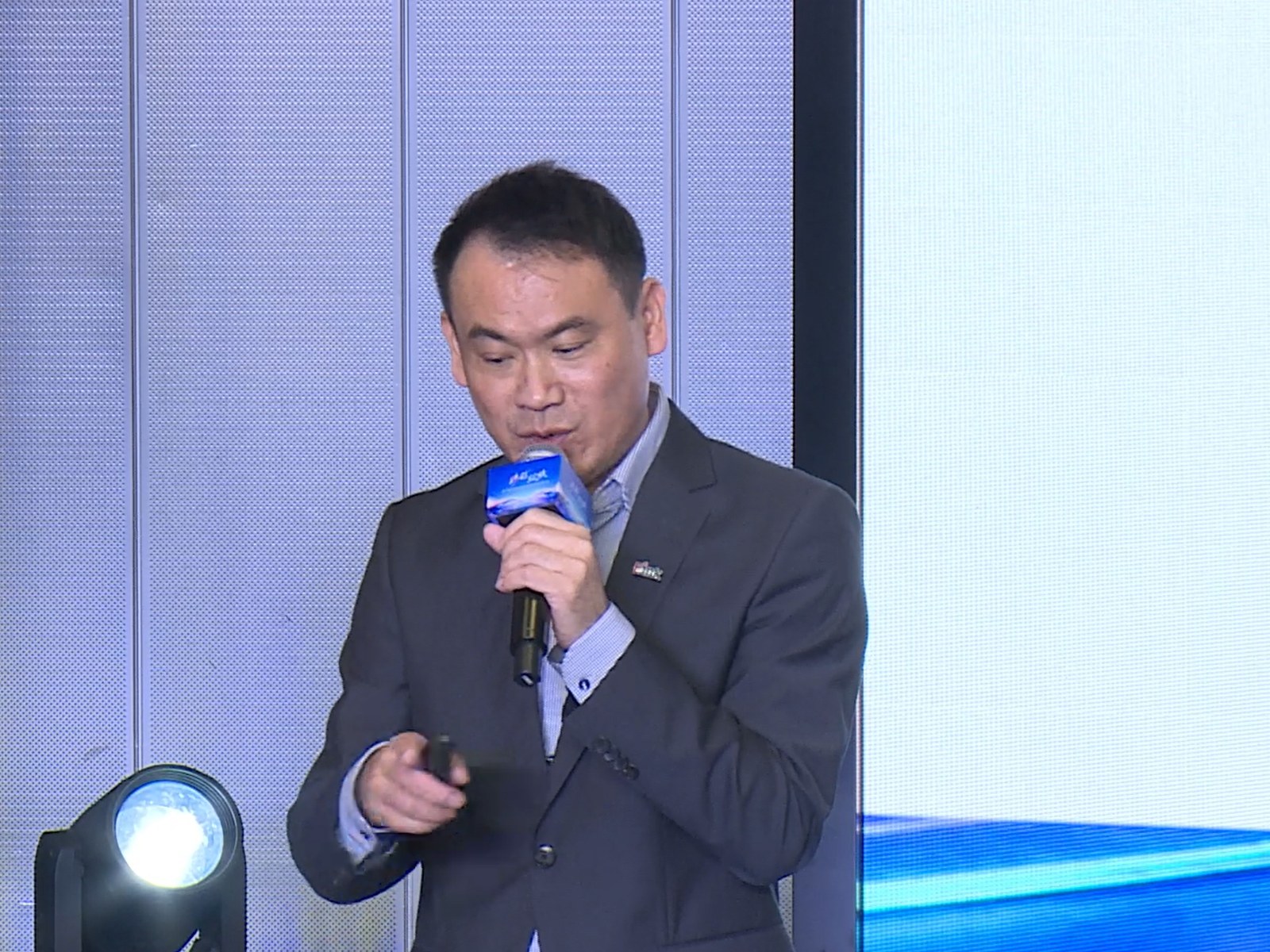
Caption: Gary Chin (景己倉), Senior Director of E Ink's CE Business Unit, presenting Kaleido 4. His talk was titled "Technical Breakthroughs and Experience Upgrades in Color ePaper." Source: Hanvon livestream on bilibili
One slide in Gary Chin's talk was headlined "2026, E Ink Kaleido 4 is here!" It showed an exploded view of the display stack with five layers, three of them highlighted in blue as new: a new front light design, a printed color filter, and an Oxide TFT backplane. The touch panel and the microcapsules (the electronic ink itself) were not marked as new.
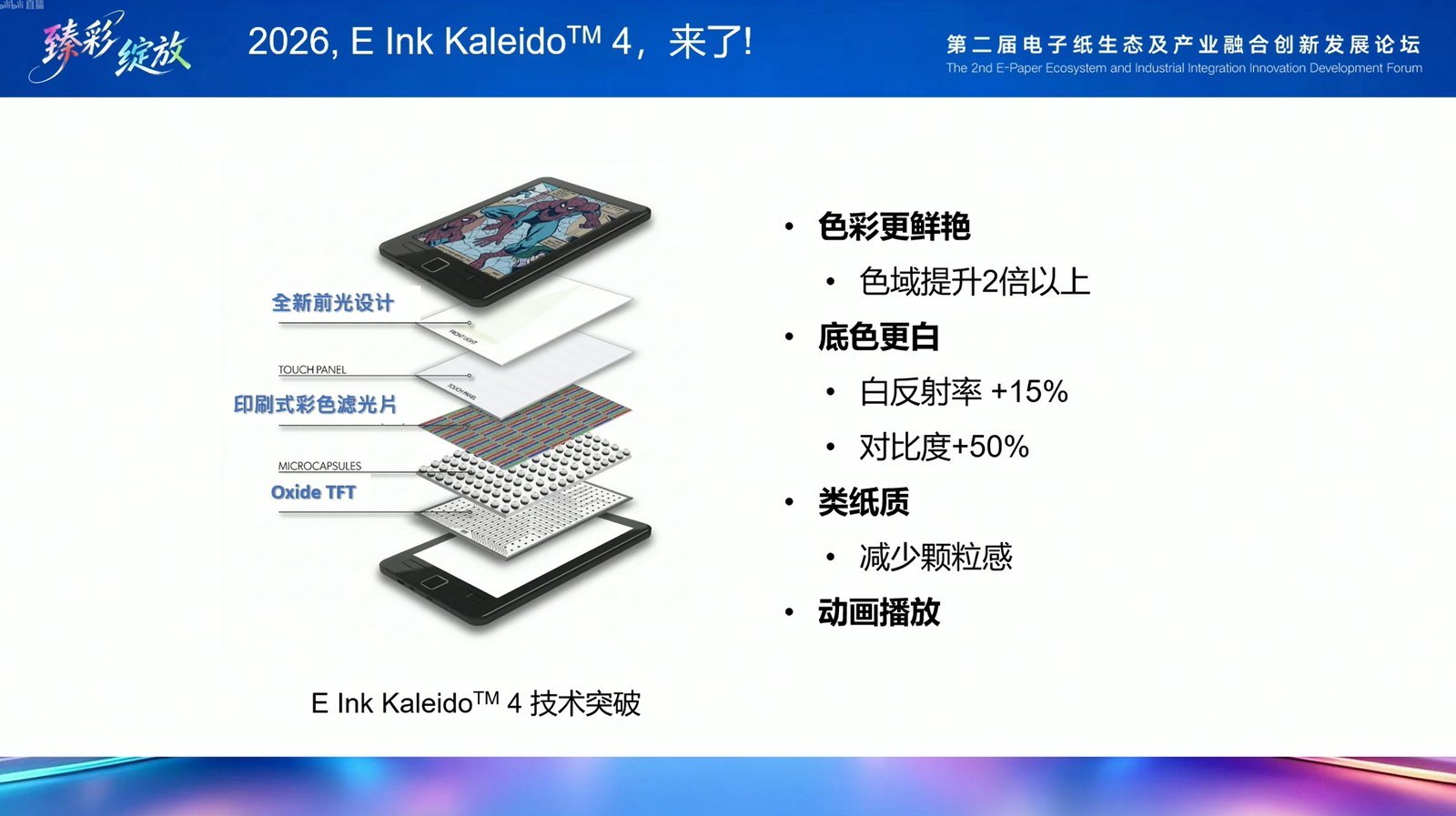
Caption: E Ink's Kaleido 4 overview. The front light, color filter and Oxide backplane, marked in blue, are new in this generation. Source: Hanvon livestream on bilibili
The same slide listed four improvements: more vivid color, with the color gamut up by more than 2x; a whiter background, with white reflectance up 15% and contrast up 50%; a more paper-like look with less graininess; and support for animation playback.
Chin added a few details verbally (paraphrased from the livestream). The backplane moves straight to oxide, which can be driven at a higher voltage for faster response. The printing recipe for the color filter has been significantly improved. The front light is a completely new design, including new LEDs and related patents. Smoother animation comes from new waveforms. He also said the resolution is "still 300," with better printing reducing graininess.
From the context, that 300 most likely refers to the black-and-white resolution staying at 300 ppi, the same as Kaleido 3. Neither E Ink's slides nor the talk gave a color resolution or color count, so we don't yet know whether Kaleido 4 moves beyond Kaleido 3's 150 ppi and 4,096 colors.
Kaleido 4 vs Kaleido 3: claimed improvements and up to 18fps
When Hanvon introduced the M10C 2nd Gen, it showed its own Kaleido 4 slide, with two identical-looking devices labeled Kaleido 3 and Kaleido 4 side by side. That slide makes two things clear. First, the improvements are measured against Kaleido 3. Second, Hanvon added a figure E Ink didn't mention: video playback at up to 18fps.
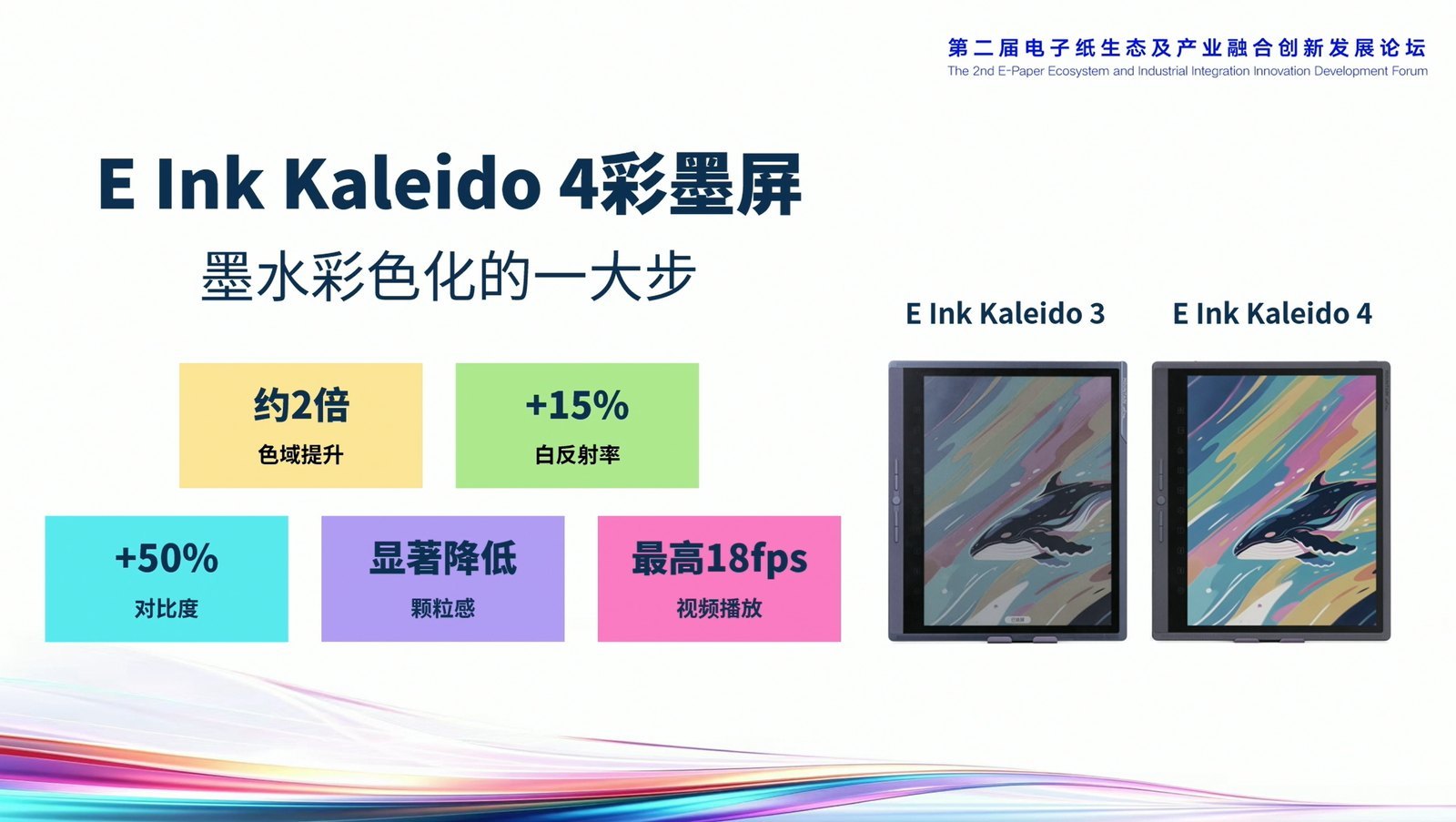
Caption: Hanvon's Kaleido 4 slide, with Kaleido 3 and Kaleido 4 compared on the right. Source: Hanvon livestream on bilibili
There is one small difference in wording. For color gamut, E Ink says "more than 2x," while Hanvon says "about 2x." The +15% white reflectance and +50% contrast figures match.
Using Kaleido 3 as the baseline makes the numbers easy to place. Elsewhere in E Ink's presentation, a slide on reading and writing devices labeled the Kindle Colorsoft and Kindle Scribe Colorsoft as E Ink Kaleido 3. If you have used either of those, or any other Kaleido 3 color reader, that is your starting point for comparison.
Behind the scenes: Kaleido 4 was delayed
Both E Ink speakers mentioned that Kaleido 4 arrived later than originally planned. The following is paraphrased from the livestream audio.
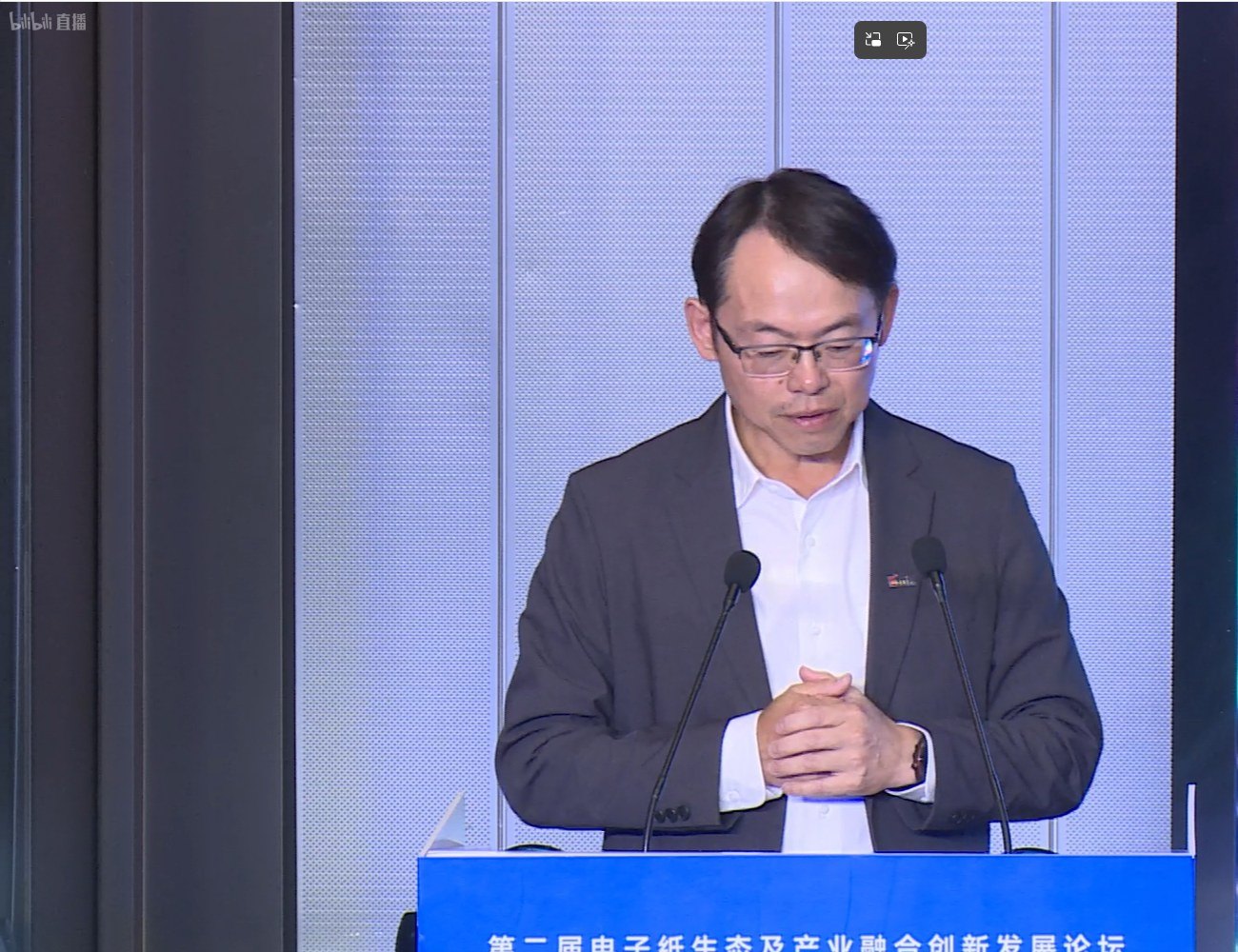
Caption: Chang Chih-ming (張志明), senior associate vice president at E Ink, giving the opening remarks. Source: Hanvon livestream on bilibili
In his opening remarks, Chang Chih-ming of E Ink said the technology should have been announced a quarter earlier, and that Hanvon and E Ink worked extremely hard together to make it ready. He stressed that E Ink usually shows prototypes at trade shows, but this time the audience was seeing a real product, not a prototype, and that people would be able to buy it soon. He said E Ink chose Hanvon as the launch partner because Hanvon understands the technology and the two companies have worked together, and trusted each other, for more than 20 years.
Gary Chin said the product might not have made it out at all, but E Ink's leadership decided to adopt the newest technology to make it better, which pushed the launch back by about two months. He also shared a naming anecdote: because the number 4 is considered unlucky in Chinese, the name was debated internally, until the boss decided to stick with the number, just as there was an iPhone 14.
That takes us back to COMPUTEX in June. Netronix showed a 10.3-inch panel labeled "New Kaleido" at its booth, with a spec card listing 150 ppi color and 4,096 colors. In our report from the show, we concluded it was still a Kaleido 3–class panel. E Ink has not explained how that panel relates to today's Kaleido 4, and we can't confirm it either way.
Hanvon's Liu Yingjian: going paperless in this generation
Hanvon chairman Liu Yingjian (劉迎建) also spoke. He founded Hanvon, which made its name in Chinese handwriting recognition. We covered the company's history in our Hanvon brand profile.
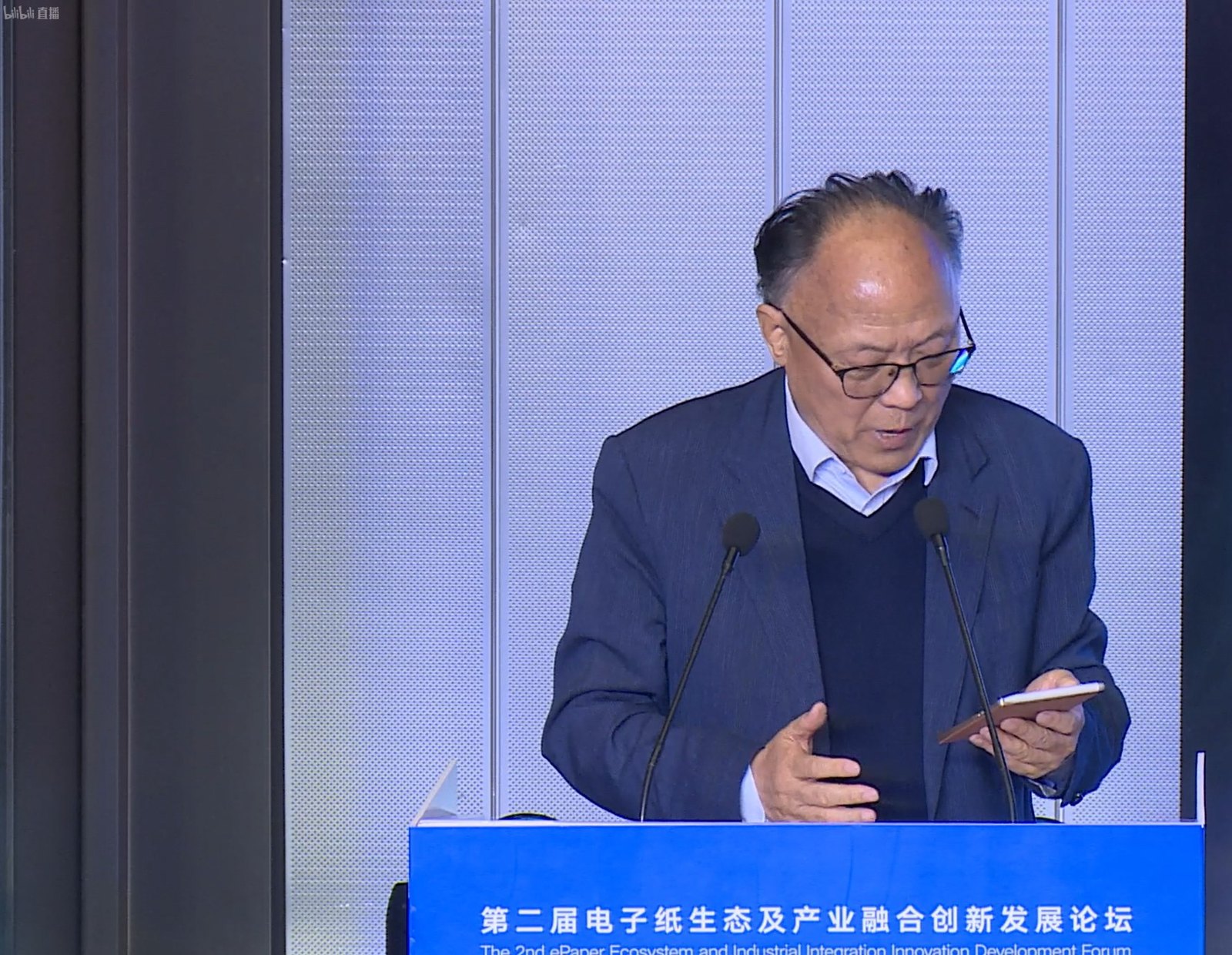
Caption: Hanvon chairman Liu Yingjian read his speech from an ePaper device. Source: Hanvon livestream on bilibili
One nice detail: Liu didn't read from paper. He held an ePaper device, and opened by saying this is what going paperless looks like, joking that with his farsightedness he can make the text as large as he likes. He said his life's goal has shifted from Chinese character recognition to making work paperless, something he hopes to finish within his generation, and called today's topic, the breakthrough in color, a milestone on that path. He also praised Taiwan's E Ink and mentioned his friendship with the company's previous chairman (paraphrased from the livestream).
Hanvon M10C 2nd Gen: Kaleido 4 with a Qualcomm chip and T2000
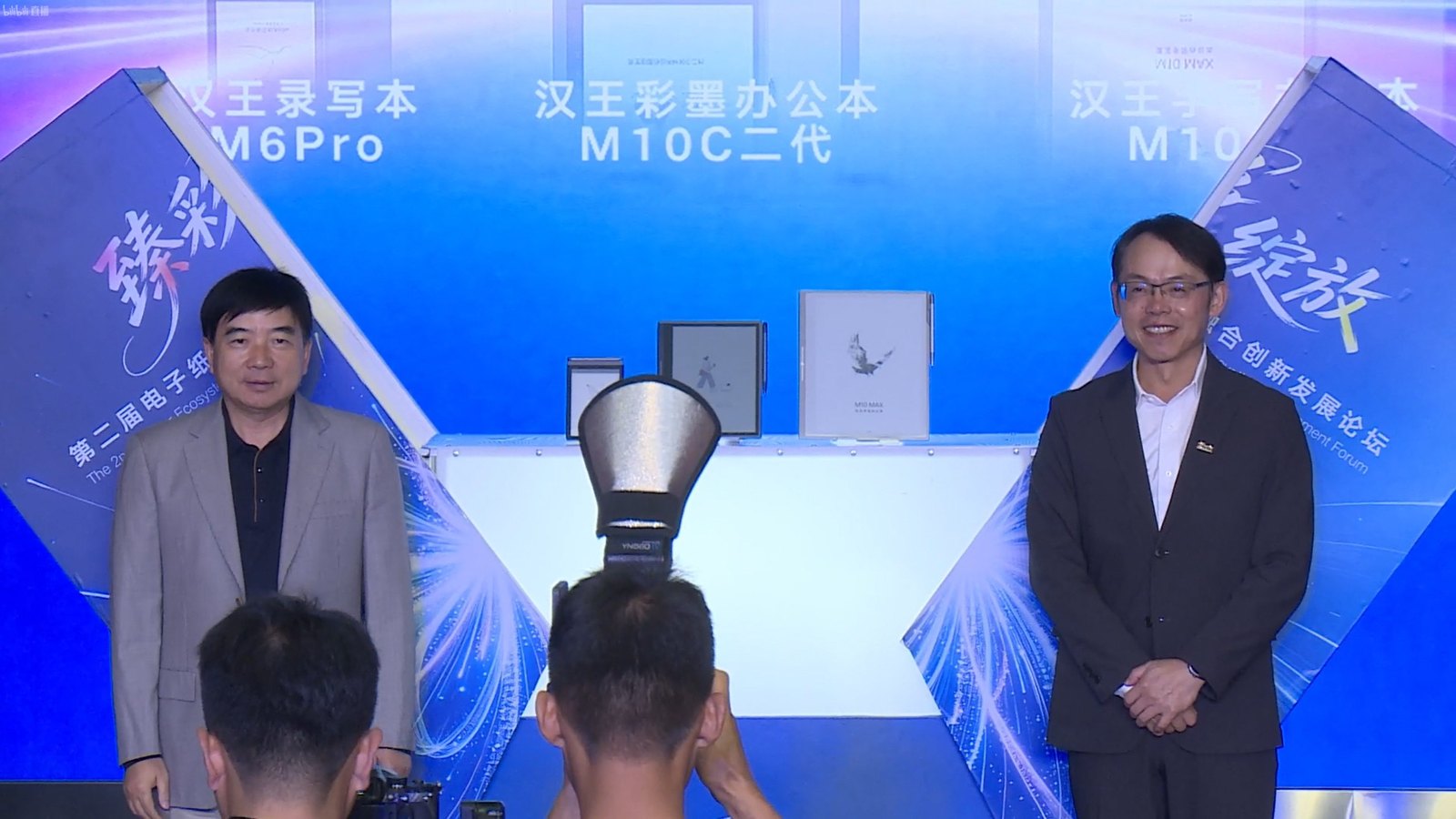
Caption: Representatives from Hanvon and E Ink unveiling the three new devices. Source: Hanvon livestream on bilibili
The M10C 2nd Gen is Hanvon's second color ePaper office notebook. Its headline specs are a Kaleido 4 display, what Hanvon calls an "Oxide boosted display" paired with a "T2000 fast-refresh engine," a Qualcomm 4nm octa-core processor (listed as 2.2GHz on the overview slide), 4GB of RAM and 128GB of storage, and a passive electromagnetic pen that needs no charging.
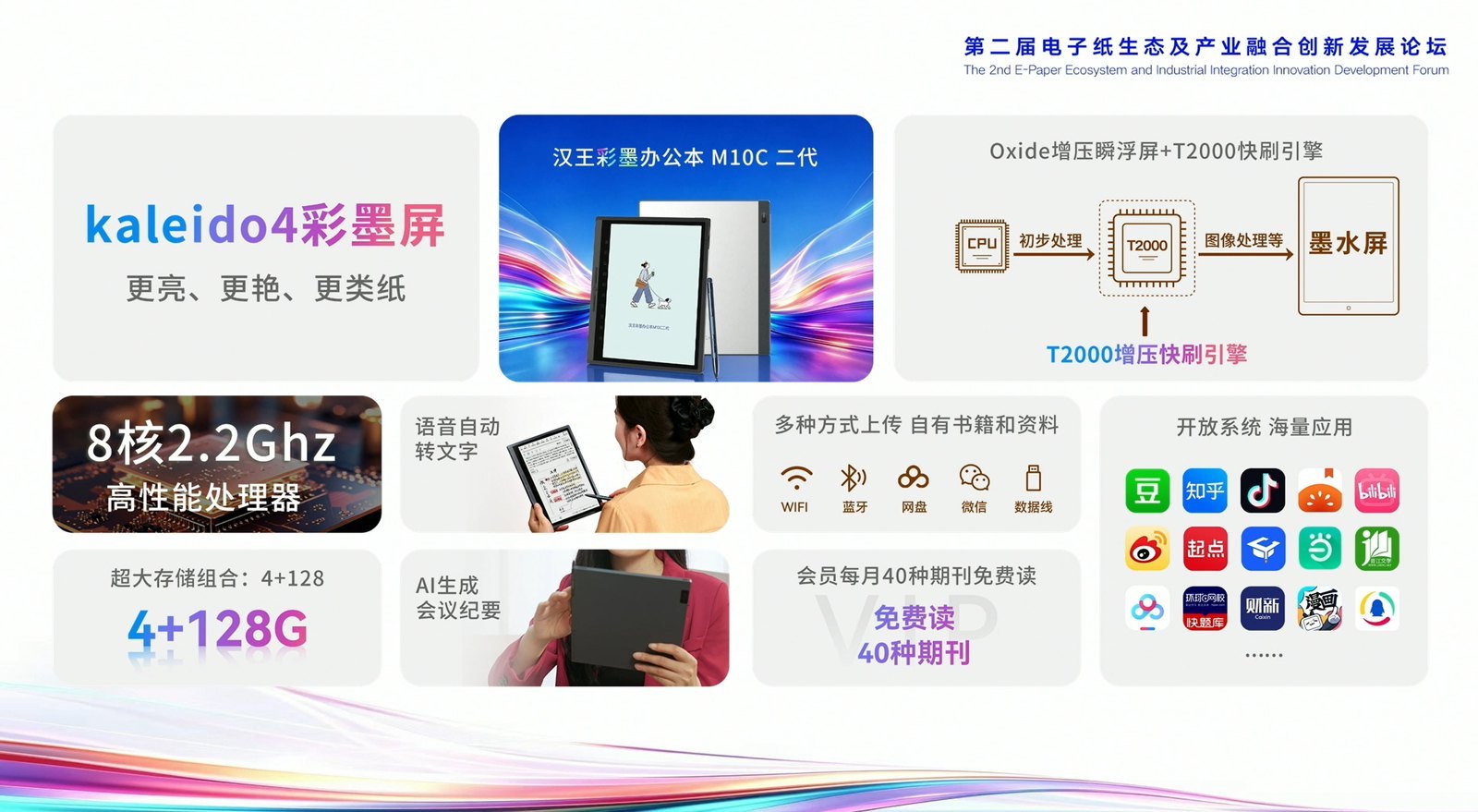
Caption: M10C 2nd Gen overview. The diagram at top right places the T2000 between the processor and the ePaper display. Source: Hanvon livestream on bilibili
The diagram in the top-right corner is worth a look. The processor handles initial processing, then hands off to the T2000 for image processing before anything reaches the screen. In other words, the T2000 is a separate timing controller (TCON) chip that sits between the processor and the display.
The switch to Qualcomm is the other notable change. For the first-gen M10C, Hanvon only said "domestic flagship 8-core," and a Zhihu teardown review identified it as a Rockchip RK3576, a chip with a built-in ePaper controller. Our reading is that moving to a Qualcomm chip means a dedicated controller is needed to drive the ePaper panel, which may be one reason the T2000 is here. Hanvon has not explained the change, and it has not named the Qualcomm chip.
On the productivity side, the M10C 2nd Gen focuses on voice-to-text, AI-generated meeting minutes, syncing with PCs, tablets and phones, and a physical one-touch offline switch that keeps voice transcription working with the network cut off, pitched as a data security feature. Hanvon's target users are civil servants, designers, managers and researchers, people who regularly deal with documents marked in red, color reports, design drafts and charts in papers.
Hanvon's slides don't state the screen size. The device looks nearly identical to the 10.3-inch first-gen M10C, so we expect it to stay at 10.3 inches, but that will need official confirmation. For the first-gen specs, see our September M10C 2nd Gen preview.
Hanvon M10C 2nd Gen vs M10C and M10: specs compared
The M10C 2nd Gen belongs to Hanvon's MOUNTAIN office notebook line, and "MOUNTAIN" is printed on its bezel. In the same line, the M10 from October 2024 is the black-and-white model, and the first-gen M10C from May 2025 was Hanvon's first color ePaper notebook. Putting the three side by side shows what changed.
| M10 (black and white) | M10C (1st Gen) | M10C (2nd Gen) | |
|---|---|---|---|
| Release | October 2024 | May 2025 | Early December 2026 (planned) |
| Display | 10.3-inch black and white, 300 ppi | 10.3-inch Kaleido 3, 300 ppi B/W / 150 ppi color | Kaleido 4, size and resolution not announced |
| Display drive | Not specified | Hanvon's own "h" series display algorithms | Oxide boosted display + T2000 |
| Processor | Octa-core (model not disclosed) | Domestic octa-core (Rockchip RK3576 per Zhihu review) | Qualcomm 4nm octa-core, 2.2GHz |
| RAM / storage | 8GB + 128GB | 4GB + 128GB | 4GB + 128GB |
| OS | Android 14 | Android 14 | Not announced |
| Battery | 6,500mAh | 6,500mAh | Not announced |
| Launch price | RMB 4,199 | RMB 3,699 | Not announced |
Data for the M10 and first-gen M10C come from our device database and our September M10C 2nd Gen preview. M10C 2nd Gen data come from the forum slides.
The table shows the changes are concentrated in the display and how it is driven: Kaleido 3 becomes Kaleido 4, with an Oxide backplane and the T2000, and the processor moves from a domestic chip to Qualcomm. RAM stays at the first gen's 4GB rather than matching the black-and-white M10's 8GB. With memory prices high this year, that may be a cost decision, though Hanvon hasn't said so (our inference).
Hanvon M10 Max: A4-sized 13.3 inches with a Qualcomm Dragonwing QCS8550
The M10 Max is a black-and-white device built around a 13.3-inch screen that Hanvon says reproduces an A4 page at 1:1. It also uses the Oxide boosted display and T2000, with a Qualcomm Dragonwing QCS8550 processor, 8GB of RAM and 128GB of storage.
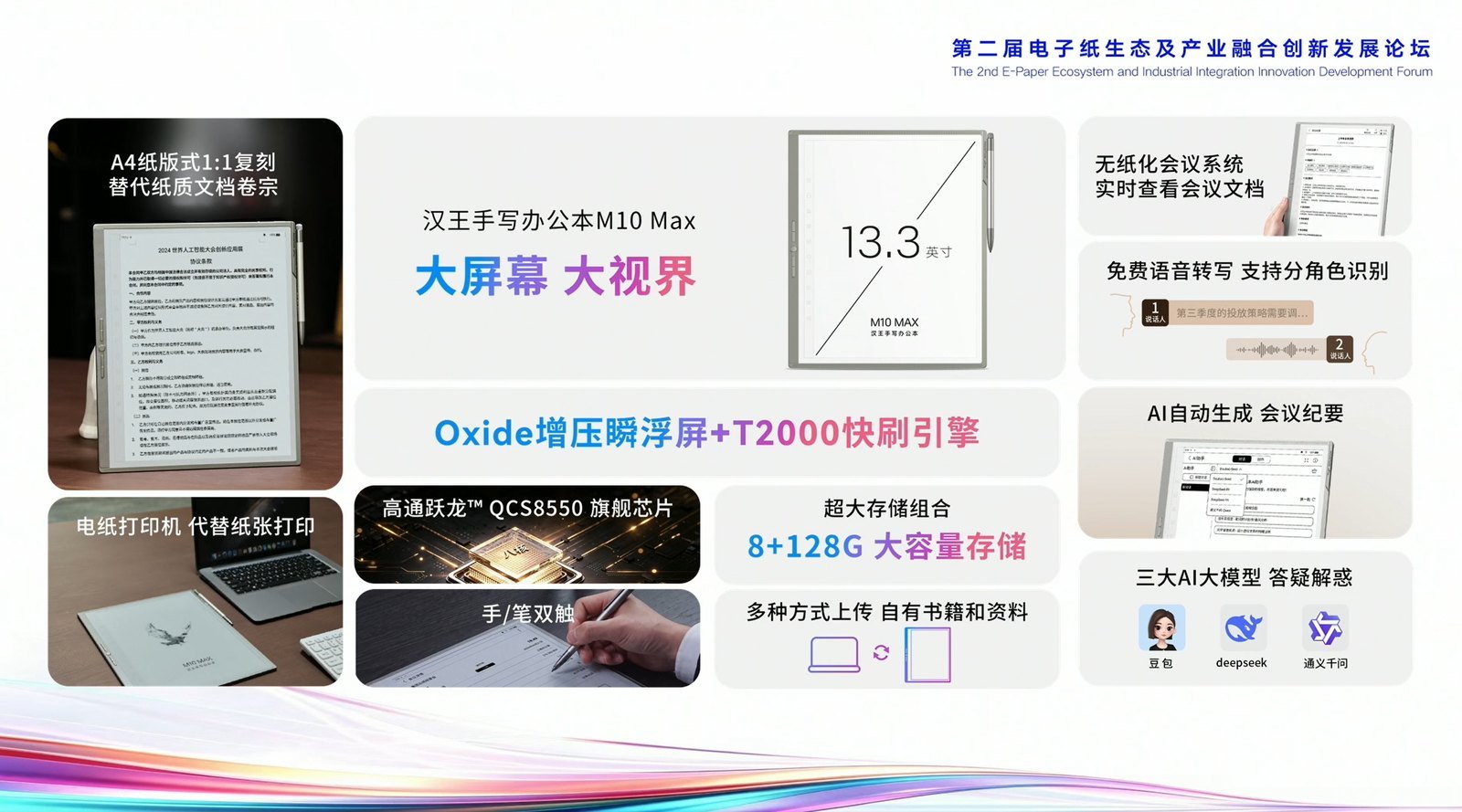
Caption: M10 Max overview. Source: Hanvon livestream on bilibili
According to Qualcomm's product brief, the QCS8550 is a 4nm octa-core chip with one 3.2GHz prime core, four 2.8GHz performance cores and three 2.0GHz efficiency cores. (The same brief's feature list gives the prime core as up to 3.36GHz, while its spec table says 3.2GHz.) It has an Adreno 740 GPU, 48 TOPS of AI performance and Wi-Fi 7, but no cellular modem. Next to the M10C 2nd Gen's 8-core 2.2GHz chip, that is a big step up. Notebookcheck describes it as essentially the IoT version of the Snapdragon 8 Gen 2. A chip of this class is rare in an ePaper notebook; Hanvon says it is there to run AI inference on the device so data doesn't need to be uploaded.
Another interesting M10 Max feature is what Hanvon calls an "ePaper printer": print from a computer and the document goes straight to the M10 Max instead of onto paper. Combined with the A4-sized screen, the device is clearly aimed at paperless meetings and document review. Hanvon's target users confirm it: researchers reading papers, managers reviewing contracts and reports, professors and students annotating course material, and government staff handling document workflows and meeting minutes.
Hanvon M6 Pro: a pocket-sized recording notepad
The M6 Pro is a 6-inch recording notepad weighing about 189g and measuring about 6.8mm thick. It has a front light and touch, a 300 ppi screen, a passive electromagnetic pen with 8,192 pressure levels and an octa-core processor, and it focuses on speaker-separated voice transcription and AI meeting minutes.
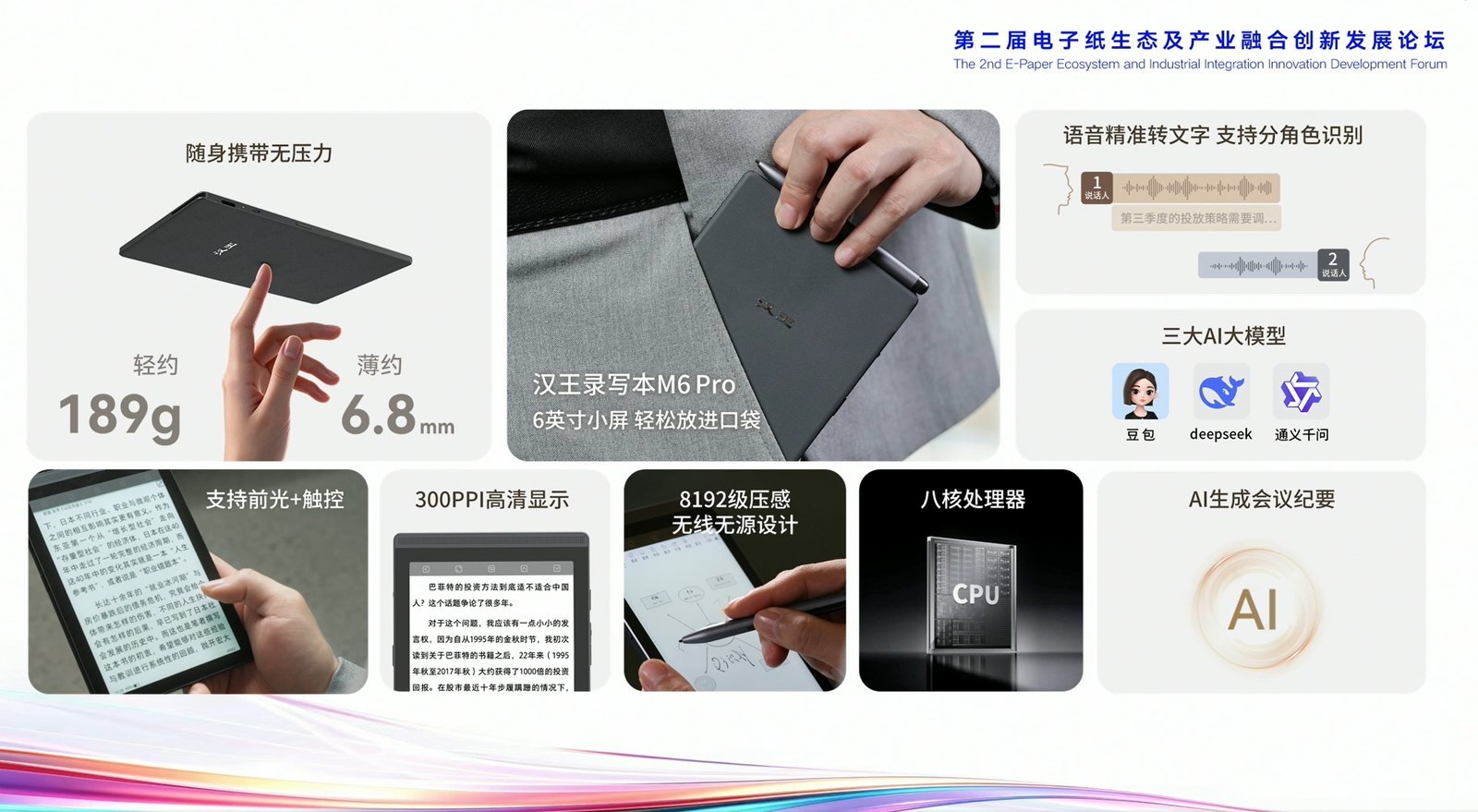
Caption: M6 Pro overview. Source: Hanvon livestream on bilibili
Hanvon splits its recording notepads into three tiers: the M6 is the base model, the N6 Pro is the high-end "reduced screen layers" model, and the M6 Pro is the high-end "all-round" model. The M6 Pro slides don't mention an Oxide backplane or T2000, so it appears to use a conventional black-and-white ePaper setup.
M10C 2nd Gen, M10 Max and M6 Pro: specs, release dates and prices
Based on Hanvon's October 15, 2026 forum slides. "Not announced" means the information was not provided at this event. Release dates are planned, not confirmed shipping dates.
| M10C 2nd Gen | M10 Max | M6 Pro | |
|---|---|---|---|
| Display | E Ink Kaleido 4 color | 13.3-inch black and white | 6-inch black and white, 300 ppi |
| Display drive | Oxide boosted display + T2000 | Oxide boosted display + T2000 | Not mentioned |
| Processor | Qualcomm 4nm octa-core, 2.2GHz | Qualcomm Dragonwing QCS8550, 4nm octa-core, up to 3.2GHz | Octa-core |
| RAM / storage | 4GB + 128GB | 8GB + 128GB | Not announced |
| Pen | Passive electromagnetic pen | Pen and touch | 8,192-level passive electromagnetic pen |
| Highlights | Color documents and reports, voice transcription, offline switch | A4 size, ePaper printer, on-device AI | 189g, 6.8mm, front light and touch |
| Planned release | Early December 2026 | Early November 2026 | Early November 2026 |
| Price | Not announced | Not announced | Not announced |
Correcting our earlier take
In our October 14 article on Netronix's investor call, we suggested Kaleido 4's main upgrade might be on the drive side, and that the color filter might not change much. That turned out to be only half right.
We were right about the Oxide backplane: E Ink lists it as one of Kaleido 4's three new layers, and the M10C 2nd Gen pairs it with the T2000. We were wrong about the color filter. E Ink explicitly marks both the printed color filter and the front light as new, and Gary Chin said the filter's printing recipe was significantly improved. Kaleido 4 is an overhaul from the front light through the color filter to the backplane, not just a new way of driving the panel.
Importing a Hanvon e-reader: Google Play, apps and warranty
The practical point first: the M10C 2nd Gen is a China-market device, and Hanvon has no official sales channel in Taiwan. The apps shown on Hanvon's slides are all Chinese apps, Google Play isn't mentioned, and the built-in AI models are Doubao, DeepSeek and Tongyi Qianwen, which may or may not work outside China. For most readers here, it is better seen as a preview of what Kaleido 4 looks like in practice than as something to buy right away.
If you are tempted to import one, watch out for Google services. China-market devices usually ship without Google Play or Google Mobile Services (GMS). Hanvon's official specs for the first-gen M10C only say "Android 14 open system," relying on Hanvon's own app store. The reading apps Taiwanese readers rely on, such as Kobo, HyRead, Readmoo, Books.com.tw, Pubu and Google Play Books, are normally installed and updated through Google Play. Without it, you have to sideload APKs and keep them updated yourself, and some apps need Google services to sign in, buy books or sync, so they may not work properly even if they install.
There are guides online for installing the Google framework yourself, but we haven't found reliable reports for the M10C series. Whether it installs, whether it is stable, and whether it survives system updates are all open questions, so we wouldn't buy one counting on it. Imports also come without a local warranty, and the interface and built-in services are designed for the Chinese market. Check that the apps you use can live with these limits before you buy.
Time to look forward to new 10-inch devices
For readers in Taiwan, the real excitement around Kaleido 4 is which brands will adopt it next. At its September investor call, Netronix, the contract manufacturer behind Kobo, said its e-readers "currently use Kaleido 4," with new products expected between the end of 2026 and early 2027. At the October 15 forum, E Ink also said that people would be able to buy Kaleido 4 products soon.
Looking at the 10-inch color devices on sale in Taiwan, this size hasn't had a real generational update in a while.
- Kobo: its only color models are the 6-inch Clara Colour and the 7-inch Libra Colour. The 10.3-inch Elipsa 2E is a black-and-white model from April 2023 and still has no color version.
- HyRead: the 10.3-inch color Gaze Pro XC is a Kaleido 3 device that went on sale in October 2024, two full years ago. HyRead's new color models this year are the 13.3-inch Gaze Pro Max C and the upcoming 7-inch Gaze Air C, with nothing new at 10 inches.
- Readmoo: the mooInk Pro 2C is a 10.3-inch Kaleido 3 device from April 2024, now two and a half years old. We have noticed demo units of the mooInk Pro line disappearing from a number of stores lately, so news of a successor is worth watching for.
- BOOX: the Note Air6 C, announced only in September, still uses Kaleido 3. The Tab Elite, which leaked in August and is the only one of BOOX's four rumored devices still unannounced, had no official specs in the sources checked for this October 15 report. Since Hanvon calls the M10C 2nd Gen the world's first Kaleido 4 product, the Tab Elite would be BOOX's most likely candidate if it wants Kaleido 4, but there is no evidence of that yet (our inference).
Putting it together: Kobo has no 10-inch color device, HyRead's and Readmoo's 10-inch color models are both more than two years old, BOOX still has the Tab Elite in reserve, and Netronix says new products are coming from late this year into early next year. Over the next few months, there is a good chance several brands will launch 10-inch Kaleido 4 devices (our inference; no brand has announced one).
If you are thinking about buying a 10-inch color reader or ePaper notebook, it may be worth waiting for hands-on reviews after the M10C 2nd Gen ships in early December, and to see whether your preferred brand follows. If you already own a Kaleido 3 device, there's no need to worry. E Ink's claimed improvements are clear, but how big the difference is in practice will only become clear with real devices.
Our take
Since Kaleido 3 launched in 2022, color ePaper has been stuck on the same panel generation for more than four years. Kaleido 4 replaces three layers at once, the front light, color filter and backplane, and E Ink has published concrete numbers, which is more than the minor refresh many people expected. As the launch partner, Hanvon putting Kaleido 4, the T2000 and a Qualcomm processor together in the M10C 2nd Gen also shows real commitment to this product line.
One small complaint about memory. The M10C 2nd Gen is pitched around an open system, AI meeting minutes, voice transcription and even 18fps video, yet it keeps the first gen's 4GB of RAM. The black-and-white M10 in the same line and the new M10 Max both have 8GB, and 10-inch color devices on sale in Taiwan, such as the Note Air6 C and Gaze Pro XC, have 6GB. For a color office notebook meant to run several productivity apps at once, 4GB feels tight. How smooth it is in practice will depend on reviews after launch.
The biggest unknown is price. The first-gen M10C launched at RMB 3,699, and rising memory costs this year have already pushed up prices for many e-readers. We hope brands won't use the new panel as an excuse for a big price jump, because color ePaper needs to stay accessible to attract new readers. We'll update once Hanvon announces pricing or other brands announce Kaleido 4 devices.
Sources
- Hanvon livestream on bilibili: 2nd E-Paper Ecosystem and Industrial Integration Innovation Development Forum
- Hanvon on Weibo: three new ePaper devices launching October 15
- Qualcomm QCS8550/QCM8550 Product Brief (PDF)
- Notebookcheck: QCS8550 and the Snapdragon 8 Gen 2
- Zhihu: in-depth Hanvon M10C review (RK3576)
- Rockchip RK3576 Brief Datasheet (PDF)
- Netronix investor conference Q&A, September 15, 2026 (PDF)
- PingWest: Hanvon president Zhu Deyong
Further reading: When will Kaleido 4 arrive?, Hanvon brand profile, Hanvon Clear7 Koi, Hanvon M10
